

When you build serverless applications on AWS, your workflows rarely live in isolation. They call payment gateways, query third-party APIs, hit databases, and depend on downstream services you don’t control. And here’s the uncomfortable truth: sooner or later, one of those dependencies will fail. The real question isn’t if but it’s whether your architecture fails gracefully or takes everything down with it.
That’s where the circuit breaker pattern comes in. Let me break down what it is, why it matters, and how you can implement it elegantly with AWS Step Functions.
What Is a Circuit Breaker, Really?
Think of a circuit breaker in your home’s electrical panel. When there’s a surge, it trips and cuts the power to protect your appliances from frying. Once things are safe again, you flip it back on. The software version works exactly the same way.
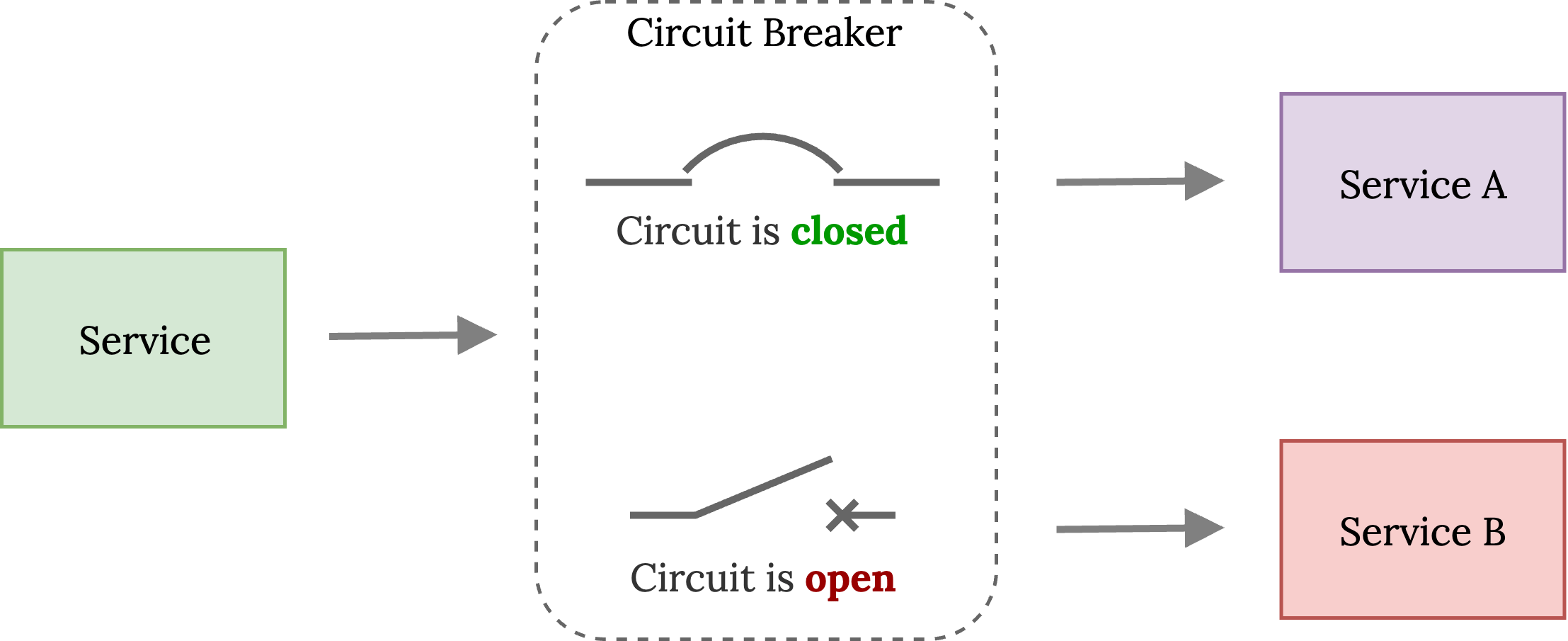
When a downstream service starts failing, a software circuit breaker “trips” and stops your application from hammering it with requests that are almost certainly going to fail anyway. Instead of piling on, you fail fast, returning an error or a fallback response immediately, and give the struggling service room to recover.
The pattern moves through three states:
Closed: Everything is healthy. Requests flow through normally, and the breaker quietly counts failures.
Open: Too many failures have piled up. The breaker trips and rejects requests immediately, without even calling the downstream service.
Half-Open: After a cooldown period, the breaker cautiously lets a few test requests through. If they succeed, it closes again. If they fail, it snaps back open.
Why You Actually Need This
It’s tempting to think retries alone will save you. They won’t and often they make things worse. Here’s why the circuit breaker earns its place in your architecture.
It prevents cascading failures. One slow dependency can exhaust your connections, threads, and Lambda concurrency. A tripped breaker contains the blast radius before it spreads.
It stops wasted spend. Every failed call to a dead API still costs you Lambda execution time and Step Functions state transitions. Failing fast is cheaper than failing slow.
It gives dependencies room to breathe. Bombarding a struggling service with retries is like everyone honking in a traffic jam. Backing off actually helps it recover.
It improves user experience. A fast, honest “try again later” beats a request that hangs for 30 seconds before timing out.
Why AWS Step Functions Is a Natural Fit
You could bake circuit breaker logic into your Lambda code, but you’d be reinventing state management, retries, and timing by hand. Step Functions already gives you these primitives out of the box, which is exactly why it’s such a clean home for this pattern.
State is first-class. Step Functions is literally a state machine. Tracking whether your breaker is open, closed, or half-open is what the service was built to do.
Built-in retries and error handling.
RetryandCatchfields let you define failure thresholds and backoff declaratively, without a single line of imperative code.Persistent tracking. Pair Step Functions with a DynamoDB table to store failure counts and timestamps, so your breaker’s state survives across executions.
Visual observability. The execution graph shows you exactly where and when the breaker tripped — invaluable when you’re debugging a 2 a.m. incident.
A Concrete Example: Protecting a NewOrder Service
Let’s ground all of this in a real scenario. Imagine an ordering system with a NewOrder microservice that handles the creation of new orders. Under heavy load or during a downstream hiccup, that service can start to struggle, and the last thing we want is to keep flooding it with requests that are doomed to fail. This is exactly the situation a circuit breaker is built for: shielding NewOrder from being overwhelmed when it’s already having a bad day.
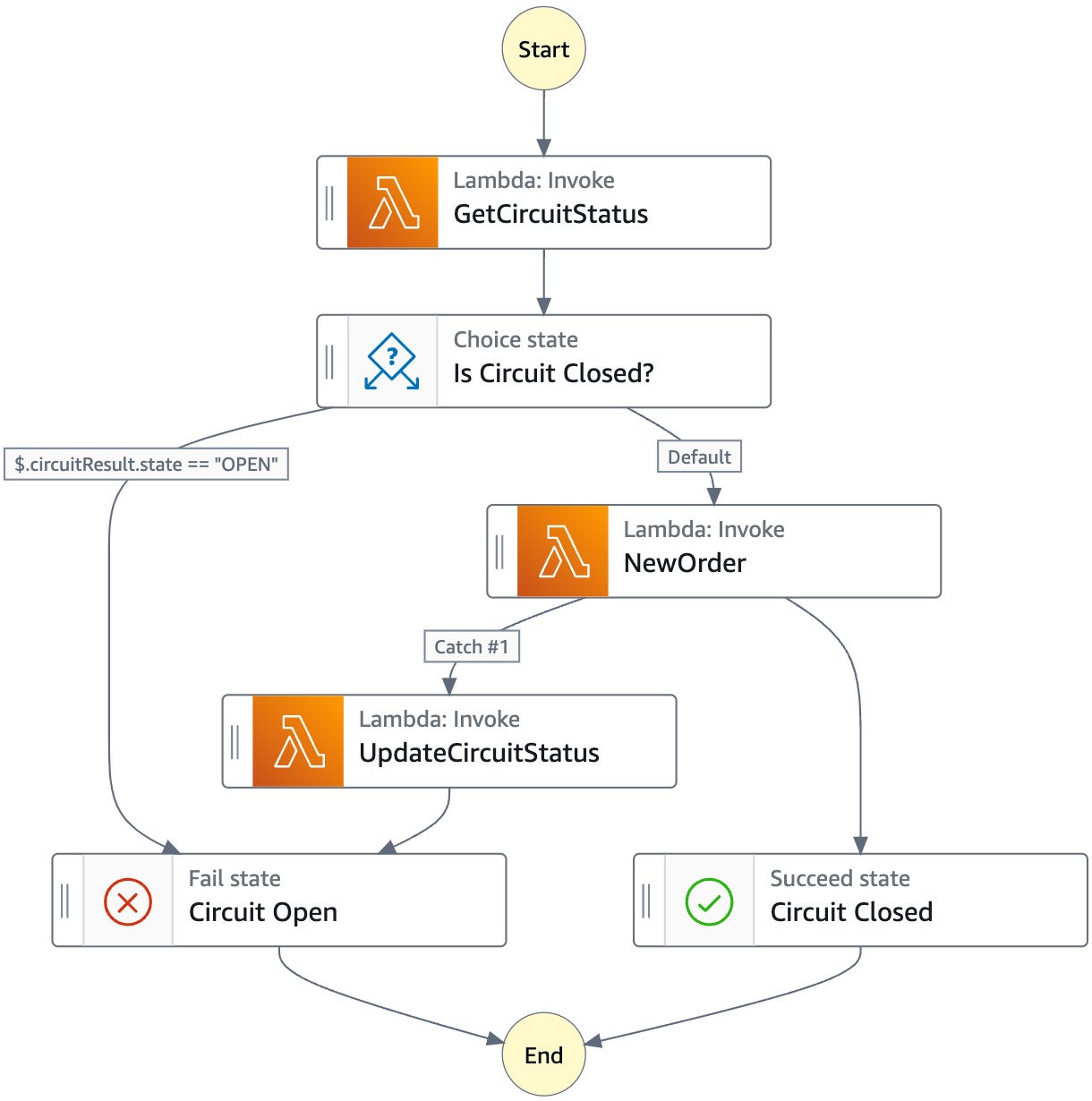
Here’s how the pieces fit together.
We store the circuit’s status, closed (allowing requests) or open (blocking them), in an Amazon DynamoDB table. Each status entry also carries a timeout that specifies when the circuit should toggle state, for example flipping from open back to closed after 10 seconds.
When an order request enters the system, a GetCircuitStatus Lambda function first queries DynamoDB to check whether the circuit to the NewOrder service is closed. If the circuit is open, the request fails immediately, no wasted call, no piling on.
If the circuit is closed, the request goes ahead and invokes the NewOrder service to create the order. But if NewOrder throws an error, because it’s overloaded or otherwise unhealthy, a second Lambda function, UpdateCircuitStatus, springs into action. It updates DynamoDB to flip the circuit state to open and sets the timeout that governs when requests to NewOrder will be allowed again.
Orchestrated with AWS Step Functions, the workflow reads as a clean state machine:
The GetCircuitStatus Lambda function retrieves the circuit status data from DynamoDB.
If the circuit is open, the state machine transitions straight to a fail state.
If the circuit is closed, the NewOrder service is invoked.
If NewOrder finishes successfully, the state machine transitions to a success state.
If NewOrder throws an error, the UpdateCircuitStatus Lambda function is triggered, updating the DynamoDB entry to set the circuit state to open and stamping a timeout.
What makes this so satisfying is how little “logic” actually lives in code. The branching, the fail-fast path, and the error handling are all expressed declaratively in the state machine, the Lambda functions simply read from and write to DynamoDB. That’s the circuit breaker pattern doing real work with very few moving parts.
Wrapping Up
The circuit breaker pattern is one of those ideas that feels optional right up until the moment it saves you. In a serverless world where you stitch together services you don’t own, resilience isn’t a luxury, it’s table stakes. And with Step Functions handling state, retries, and observability for you, this pattern goes from “nice in theory” to genuinely straightforward to implement.