

Building applications that serve users across the globe requires more than just deploying to a single region. Multi-region architectures provide low latency, high availability, and disaster recovery capabilities that are essential for modern cloud applications. In this article, we’ll explore how to architect a truly global serverless application using AWS services.
Sponsored by Salesforce

Stream the developer conference of the year. Live on Salesforce+.
Agentic AI is changing the game and Agentforce is leading the way. Stream TDX to join dozens of sessions and virtual hands-on trainings that explore the latest innovations across Agentforce, Data 360, the core platform, vibe coding, Slack, and more. All free on Salesforce+.
Tune in to TDX on Salesforce+ to:
Build hands-on skills with virtual trainings and live demos
Get roadmap insights from the leaders shaping what’s next
Access broadcast-only moments and exclusive interviews
It all kicks off with the main keynote, where you’ll experience the future of software and learn how to build it. Add it to your calendar so you don’t miss a moment.
👉 Register for free
Architecture Overview
Our multi-region architecture consists of four key components working together:
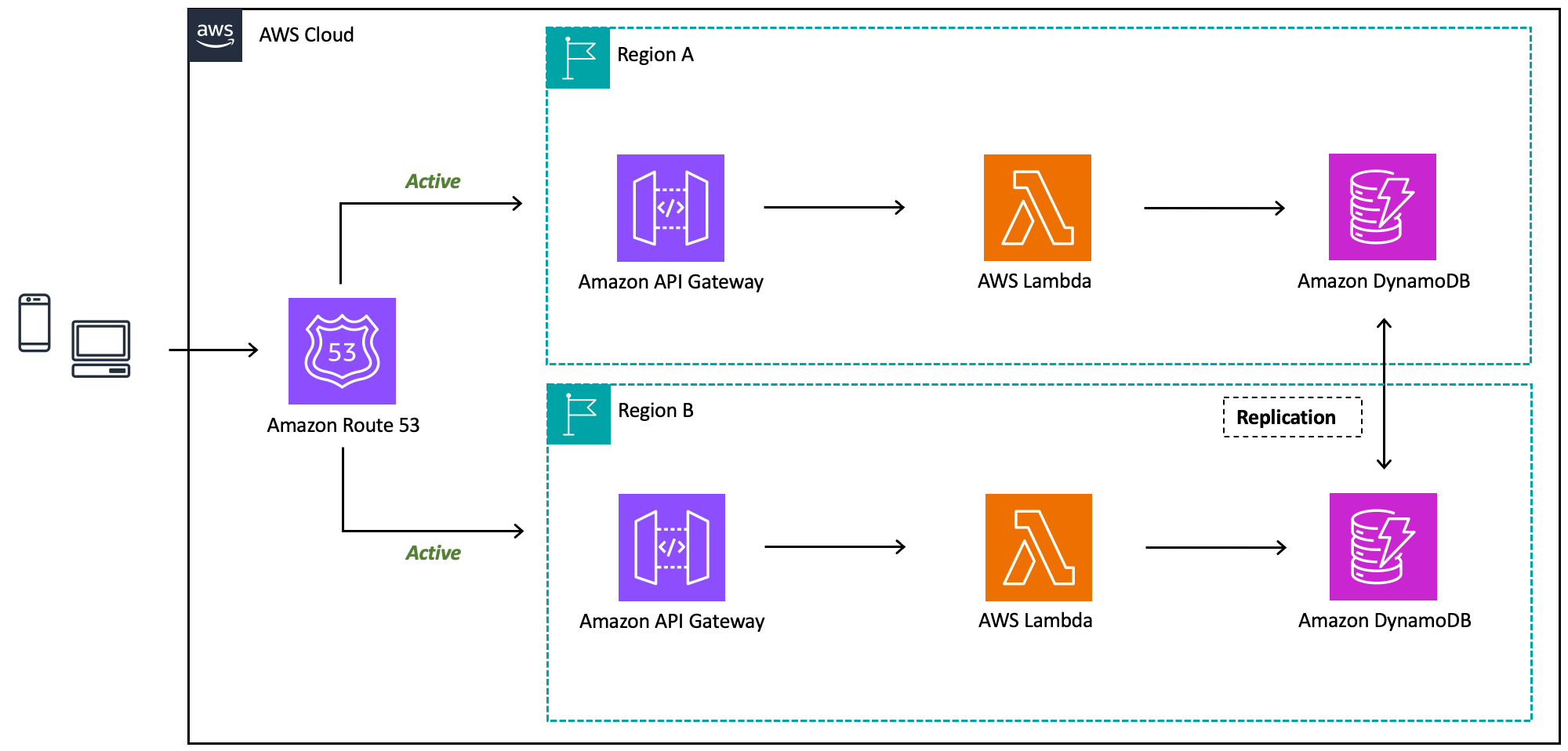
Route 53: Provides intelligent DNS routing to direct users to the nearest regional endpoint
API Gateway: Regional REST or HTTP APIs that serve as entry points in each region
Lambda: Compute layer that processes requests with minimal latency
DynamoDB Global Tables: Multi-region, fully replicated database with automatic conflict resolution
This architecture provides active-active deployment across multiple AWS regions, ensuring that if one region experiences issues, traffic automatically fails over to healthy regions.
The Architecture Flow
At the heart of a multi-region serverless architecture lies a carefully orchestrated chain of AWS services working together to deliver a seamless global experience.
Route 53: The Global Traffic Director
Amazon Route 53 serves as the entry point for all user requests. Using health checks and routing policies like latency-based or geoproximity routing, Route 53 intelligently directs users to the nearest healthy regional endpoint. This ensures that a user in Tokyo connects to the Asia Pacific region while a user in Frankfurt connects to Europe, minimizing latency and improving user experience.
API Gateway: Regional Entry Points
Each region hosts its own API Gateway endpoint, acting as the front door for that region’s serverless infrastructure. API Gateway handles request validation, throttling, and authentication before passing requests to the compute layer. With features like request/response transformation and built-in AWS WAF integration, it provides a robust security perimeter for your application.
Lambda: Distributed Compute
Behind each regional API Gateway sits AWS Lambda functions that execute your business logic. These functions are deployed identically across all regions, ensuring consistent behavior regardless of where the request originates. Lambda’s automatic scaling handles traffic spikes in each region independently, while its pay-per-use model keeps costs optimized even with a multi-region footprint.
DynamoDB Global Tables: The Data Layer
The foundation of this architecture is DynamoDB Global Tables, which provides fully managed, multi-region, multi-active database replication. When a Lambda function writes data in one region, DynamoDB automatically replicates that data to all other configured regions, typically within seconds. This means users can read and write data from their nearest region while maintaining global consistency.
Key Architectural Considerations
Conflict Resolution: DynamoDB Global Tables uses a last-writer-wins reconciliation strategy. Your application design should account for this, potentially using timestamps or version numbers to handle concurrent updates across regions.
Replication Lag: While DynamoDB replication is fast, there’s still a brief window where data might not be consistent across all regions. Design your application to handle eventual consistency gracefully.
Regional Failover: Route 53 health checks continuously monitor your regional endpoints. If a region becomes unhealthy, traffic automatically routes to the next best region, providing transparent failover without user intervention.
Cost Implications: Running infrastructure in multiple regions increases costs through data transfer charges and duplicated resources. Balance the number of regions against your actual user distribution and availability requirements.
The Benefits
This architecture delivers several compelling advantages. Users experience lower latency by connecting to nearby infrastructure. Your application remains available even if an entire AWS region experiences an outage. Data is protected through geographic redundancy. And perhaps most importantly, you can scale globally without redesigning your architecture.
When to Use This Pattern
Multi-region architectures make sense for applications with a global user base, strict availability requirements, or regulatory needs for data residency. However, they add complexity and cost, so evaluate whether your application truly needs global distribution or if a single-region deployment with good disaster recovery would suffice.
Conclusion
Building a multi-region serverless architecture with Route 53, API Gateway, Lambda, and DynamoDB Global Tables provides a robust foundation for globally distributed applications. This architecture delivers low-latency responses to users worldwide while maintaining high availability and disaster recovery capabilities.
The key to success is embracing eventual consistency, implementing comprehensive monitoring, and regularly testing your failover mechanisms. While the initial setup requires careful planning, the operational benefits of automatic scaling, reduced latency, and improved reliability make it worthwhile for applications serving a global user base.